
The Modern Dog Is Not the Problem: An Evolutionary Look at Canine Needs
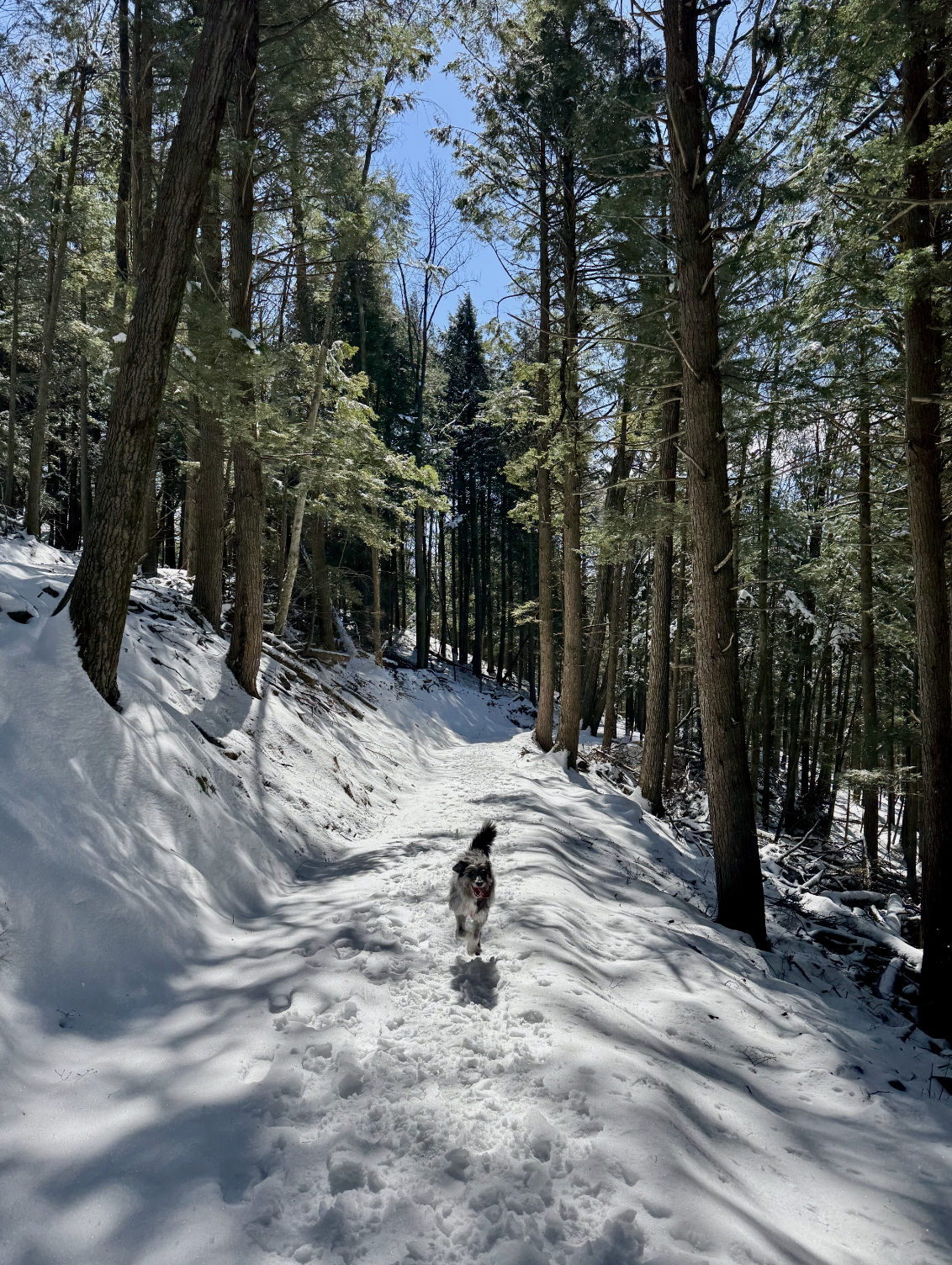
On my walk with my dog this morning, I got to thinking about how dogs’ living situation changed over the last millennium.
In studying dogs, I started to notice a pattern: Dogs aren’t “stubborn,” “hyper,” or “difficult.” They’re often trying to meet needs that no longer have an outlet.
To understand why, we need to zoom out a little bit and get not just into behavior, but into evolution.
What Dogs Actually Need (An Ethological Overview)
An ethogram describes the full range of species-typical behaviors—what a dog is biologically wired to do. While there is no single standardized ethogram for dogs yet, research consistently shows that canine behavior is composed of recurring, functional patterns shared across the genus Canis (ScienceDirect).
When we translate those patterns into needs, we get something much more complex than “they just need exercise and love.”
Core Ethological Needs
Foraging & Scavenging
Dogs are natural opportunistic feeders. Free-ranging dogs spend significant time searching, evaluating, and manipulating food. (Science Direct)Predatory Sequence Behavior
Search → orient → stalk → chase → grab → dissect → consume
Even in pet dogs, this sequence remains structurally intact, though often modified by breeding. (Science Direct)Exploration (Especially Through Scent)
Dogs experience the world primarily through olfaction, using scent to gather information and make decisions. (PMC)Social Behavior
Dogs are social mammals capable of forming flexible social systems with both dogs and humans. (Science Advances)Cognitive Engagement
Problem-solving, learning, and environmental interaction are essential for behavioral health. (PMC)Rest & Recovery
Dogs require significant sleep and downtime to regulate their nervous systems. (Science Direct)Agency & Choice
The ability to influence outcomes—where to go, what to investigate, whether to engage—is a critical but often overlooked need. (Journal of Animal Environment)
The Evolutionary Mismatch
Here’s the key insight:
Dogs have not changed nearly as fast as their environment.
I took a look at the last 1,000 years—and especially the last 100—to examine how we’ve radically altered how dogs live. Their species-specific needs stayed largely the same. Their opportunities to meet those needs did not.
Then vs. Now: A Behavioral Timeline
1000 Years Ago — The Self-Regulating Dog
Free-roaming or semi-free
Foraging and scavenging daily
Functional roles (hunting, guarding)
High autonomy and social flexibility
These dogs’ needs were mostly met, naturally, as a byproduct of simply living their lives alongside humans. They could sleep when and where they wanted, befriend who they wanted, sniff and explore, and eat trash to their hearts’ content.
100 Years Ago — The Working Companion
Increasing human structure to the dogs’ lives
Still engaged in work (herding, guarding)
Some confinement begins (leashing, chaining, enclosures)
Working dogs’ needs were largely met through purpose and labor, though their autonomy begins to decline. Less foraging, scavenging, sniffing, exploring. Less variety in nutrition with the rise of the pet food industry. (Science Direct)
Food for thought: As soon as dogs entered our living spaces, they were no longer able to eliminate whenever they needed. Humans now decided on their potty time, often at the expense of the dogs’ wellbeing (GoodRX). Is there any other animal on the planet whose most basic need of peeing and pooping when needed is determined by us?
50 Years Ago — The Suburban Dog
Rise of fenced yards, and barrier frustration (PMC)
Decline in working roles
More time alone (Science Direct)
Most of the dogs then still had their physical needs met, but with more of a human focus on “What would the neighbors think”, and subsequent obedience training, a lot of them didn’t get much of a chance to sniff and explore on their walks. Rather they had to display a perfect “heeling” position during their limited time outside. No foraging, scavenging, limited exploring on their own. Their cognitive and predatory outlets were greatly reduced, their social contacts controlled and supervised.
Today — The Controlled Companion
Highly managed lives (PMC)
Limited freedom and agency, (Psychology Today)
The advent of tight confinement and longer isolation (Science Direct)
High stimulation, low control environments (Psychology Today)
Many of our canine buddies’ core needs are now fragmented, suppressed, or artificially replaced. There is little interest in species-appropriate outlets, or learning about a dog’s needs and how they express them. And there is a dramatic rise in fear and anxiety in dogs. (AVMA)
The Shift in Needs Fulfillment
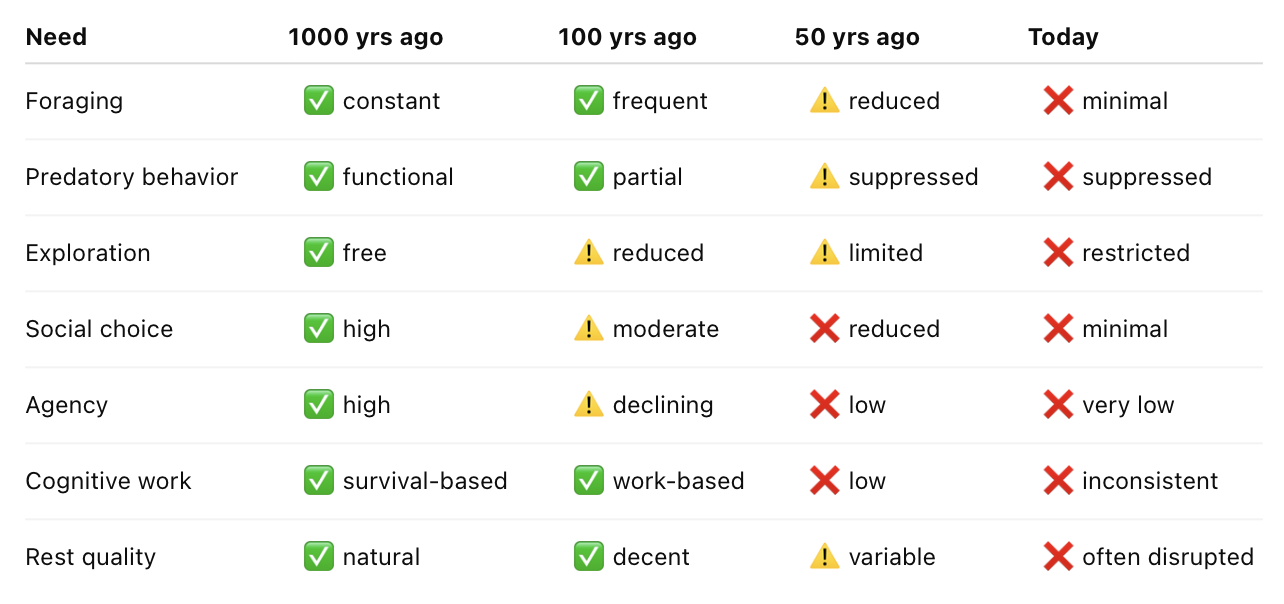
Table: A look at the evolution of dog needs fulfillment over the last 1000 years
What This Explains About Behavior
When we see:
Leash reactivity
Separation anxiety
Destruction
Hyperactivity
“Non-compliance”
We’re often not seeing disobedience, we’re seeing unmet ethological needs.
For example:
A dog pulling on leash may be expressing blocked exploration
A dog shredding furniture may be seeking foraging and dissection outlets
A dog who “won’t listen” may be experiencing loss of agency and conflict
We Have To Reframe “Training”
Instead of asking “How do I stop this behavior?”. we should consider “What need is this behavior trying to meet?”
This shift moves us from control to understanding, and from a suppression of needs to species-appropriate fulfillment.
Why This Matters
Modern dogs are living in environments that are, in many ways, biologically incompatible with their evolutionary design. That doesn’t mean something is wrong with the dog. It means we need to design better environments for them. And it’s actually not that hard. You can create enrichment in the smallest spaces, and allow for mental stimulation on each and every walk.
When we give dogs
opportunities to forage
outlets for predatory behavior
space to explore
meaningful choice
and true rest
… behavior doesn’t need to be “fixed.” Conflict starts to resolve on its own.
All behavior is communication.
If we want to truly support dogs—whether in training, daycare, or daily life—we don’t start with obedience. We start with biology. And from there, we build a relationship and a care framework that makes a lot of training obsolete.
Additional Reading
Iben Myer et al. (2022) Pampered pets or poor bastards? The welfare of dogs kept as companion animals, Applied Animal Behaviour Science (Science Direct)
Broseghini et al. (2024). Ethogram of the predatory sequence of dogs (Canis familiaris), Applied Animal Behaviour Science (Science Direct)
Laura Saiz i Vivas and Xavier Manteca Vilanova (2026), Dog Ethogram: Review of Existing Ethograms, Journal of Veterinary Behaviour (ScienceDirect)
Kowalczyk-Jabłońska I, Jundziłł-Bogusiewicz P, Kaleta T. The Role of Olfaction in Dogs: Evolution, Biology, and Human-Oriented Work. Animals. 2026; 16(3):427. (NIH)